KnowEdge Publishing
Most AI automation projects don't fail at the model. They fail at the joints between systems — the parts that never show up in a demo: what happens when the model is confident and wrong, what happens when a webhook fires twice, what happens when a five-step pipeline dies on step three and nobody notices for a week.
If you've shipped more than one AI-powered workflow into production, you've already met this problem. The fix isn't a better prompt. It's treating "AI" as a layer in your operating stack — with its own architecture — instead of a chatbot bolted onto whatever process already existed.
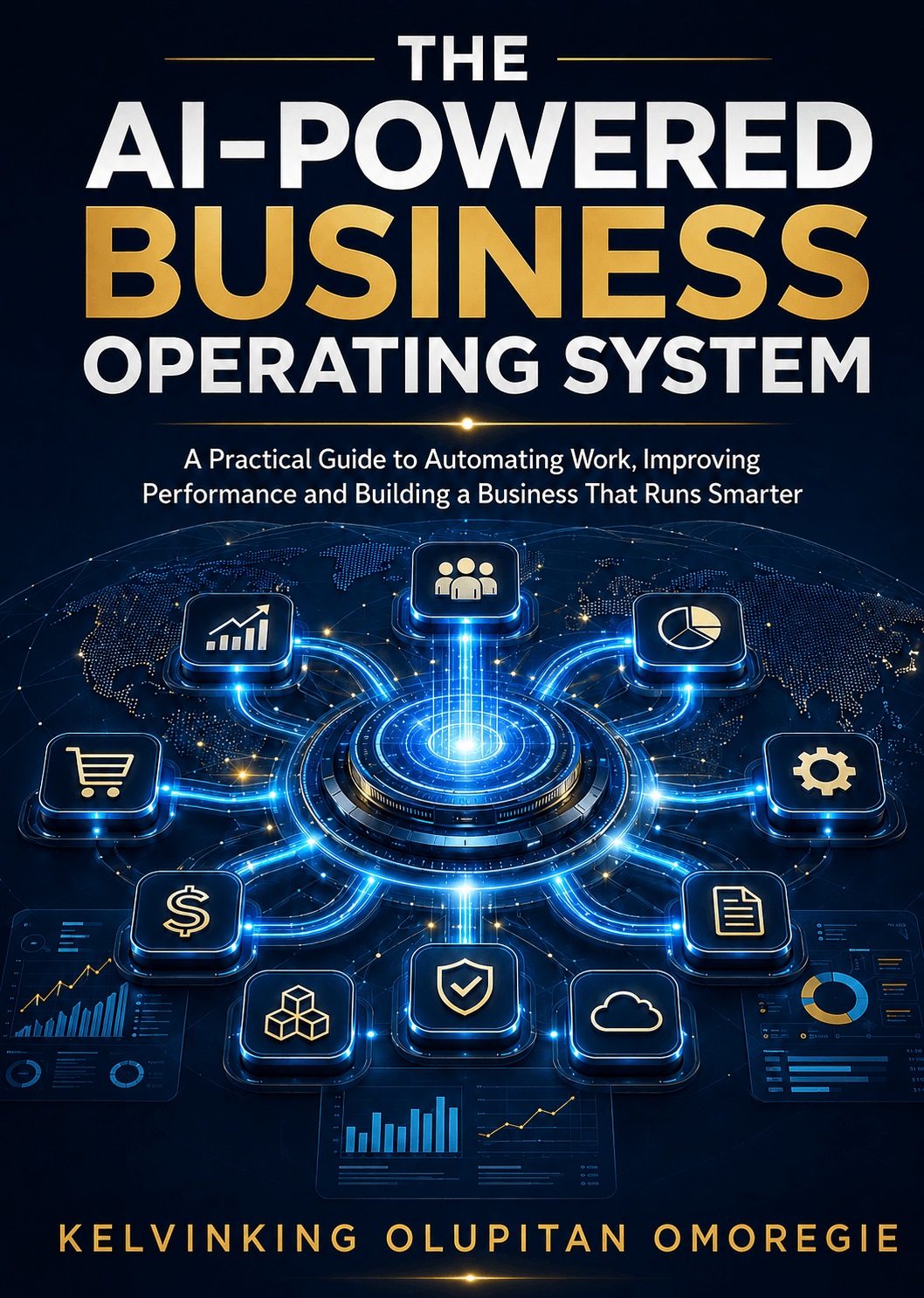
That's the core argument in The AI-Powered Business Operating System: AI belongs in the architecture diagram, not just the feature list. Below is the reference architecture worth having in mind before you wire a model into anything that touches real customers, real money, or real operations — four layers, each solving exactly one job.
The four layers
| Layer | Job | Fails silently when... |
|---|---|---|
| Context | Feeds the model the right facts, at the right moment | Stale or missing data reaches the model with total confidence |
| Orchestration | Decides what runs, in what order, and what happens on failure | A step fails and nothing downstream ever finds out |
| Execution | Actually does the work — agents, tool calls, API writes | The same action re-runs on retry, duplicating a side effect |
| Guardrail | Checks output before it reaches a human or another system | Fluent output gets mistaken for correct output |
Each of these maps to a concrete build decision, not a vague principle.
1. Context: the model only knows what you hand it
A model has no persistent memory of your business. Every call starts from zero except for what you explicitly inject — which means "context" is really a data engineering problem wearing an AI costume. The two mistakes that show up over and over:
- Dumping too much in. A bloated context window doesn't just cost tokens — retrieval quality degrades as relevant facts get buried in irrelevant ones. Retrieve narrowly; a well-targeted 500 tokens beats an unfiltered 50,000.
- Trusting stale context as current. A customer record fetched at the start of a long-running agent loop can be minutes old by the time the model acts on it. If the action is consequential (a refund, a price change, an email to a client), re-fetch immediately before acting, not once at the start of the run.
2. Orchestration: state, not scripts
A chain of prompts is not a workflow. A workflow has explicit state — what step are we on, what's already succeeded, what should happen if this step fails — that survives a crash, a redeploy, or a process restart. The question to ask before building any multi-step AI process: if this dies on step 3 of 7, can I tell which steps already ran, and can I resume without re-doing (or re-charging, or re-emailing) steps 1 and 2?
If the honest answer is "no, we'd have to check by hand," you don't have orchestration — you have a script that happens to call a model.
3. Execution: idempotency is the whole game
This is where most real incidents come from, and it has nothing to do with model quality. Agents call tools; tools have side effects; networks retry. An agent that sends an email, charges a card, or writes to a database needs every one of those actions to be safe to run twice, because in a distributed system, something will eventually run twice — a timeout that actually succeeded, a webhook redelivery, a retry after a 500 that already committed.
Important
The single highest-leverage fix in most AI-agent stacks isn't a better prompt — it's an idempotency key on every action a model is allowed to trigger.1
Without one, "the AI sent the invoice twice" isn't a hypothetical bug report. It's a Tuesday.
4. Guardrail: evaluation before delivery
Guardrails aren't a content filter bolted on at the end — they're the layer that separates fluent from correct. A model that's wrong will still sound confident; nothing about its tone signals uncertainty the way a hesitant human would. Practical guardrails that scale without a human reviewing every output:
- Schema validation on anything structured — if the model is supposed to return a category, an amount, or a status, validate it against a fixed set of allowed values before it reaches the next system, not after.
- A second, cheaper model as a checker for anything high-stakes — asking "does this output actually satisfy the original instruction?" is a narrower, easier task than generating the output in the first place, and catches a meaningful share of failures generation-time checks miss.
- A human-in-the-loop threshold, not a human-in-the-loop-always — route to a person only above a defined risk/dollar/confidence line, and measure that threshold's error rate over time instead of setting it once and forgetting it.
Why this order matters
These four layers have a dependency order, and skipping ahead is the most common way these projects go sideways: teams build execution (agents calling tools) before they've solved context (what the agent actually knows) or orchestration (what happens when a step fails). The demo works because the happy path is short. Production isn't a happy path — it's thousands of edge cases wearing the same UI.
The AI-Powered Business Operating System walks through this exact stack end to end, built for operators without a software team behind them — the same context → orchestration → execution → guardrail sequence, applied to the workflows a real business actually runs on: sales follow-up, support triage, reporting, internal ops. If you're past the "cool demo" stage and into "this needs to survive contact with real customers," that's the gap it's written to close.
- An idempotency key is a unique identifier generated once per logical action (not per retry) and checked against a record of already-processed keys before the action executes — the same pattern payment gateways like Stripe have used for years to make "charge this card" safe to call twice. ↩