KnowEdge Publishing
The skills gap nobody put in a job description
Six months ago, "using AI at work" meant knowing how to write a decent prompt. Today it means something closer to judgment: knowing when to trust a model's output, when to override it, and how to prove — to a manager, a client, or yourself — that the work you shipped is actually better because of it.
That gap is showing up faster than most job descriptions can update. A growing share of daily tasks across nearly every white-collar role can now be partially automated. But "automatable" and "should be automated" are different questions, and answering them well is quickly becoming the real differentiator between professionals who thrive alongside AI and professionals who quietly become replaceable by it.
It's not a tools problem
Most advice on this subject still reads like a software tutorial: which model, which plugin, which prompt template. That's the easy part. The harder part — the part that actually determines whether AI makes you more valuable or just faster at producing average work — is structural:
- What should you verify, every time, before AI-assisted output leaves your hands?
- Which tasks are safe to augment, and which ones lose their value the moment a human stops doing them personally?
- What capabilities are worth learning deeply now, versus a trick that won't matter in eighteen months?
- Where does your judgment — not your output — become the thing you're actually paid for?
- How do you prove, with something more concrete than a feeling, that your AI-assisted work produced a measurably better result?
Professionals who can answer those consistently aren't worried about AI. They're the ones a manager hands the ambiguous project to, because they've shown they know where to point the tool and where to stop it.
Building the habit, not just the skill
The uncomfortable truth is that most "AI training" stops at the tool layer and never reaches the judgment layer — which is exactly the part that doesn't get automated away. Building it isn't a weekend project. It looks more like an operating system for how you work: a way of mapping which tasks are genuinely exposed to automation, a personal workflow for using AI safely on the ones that are, and a habit of evidencing your results so the value you're adding is visible, not assumed.
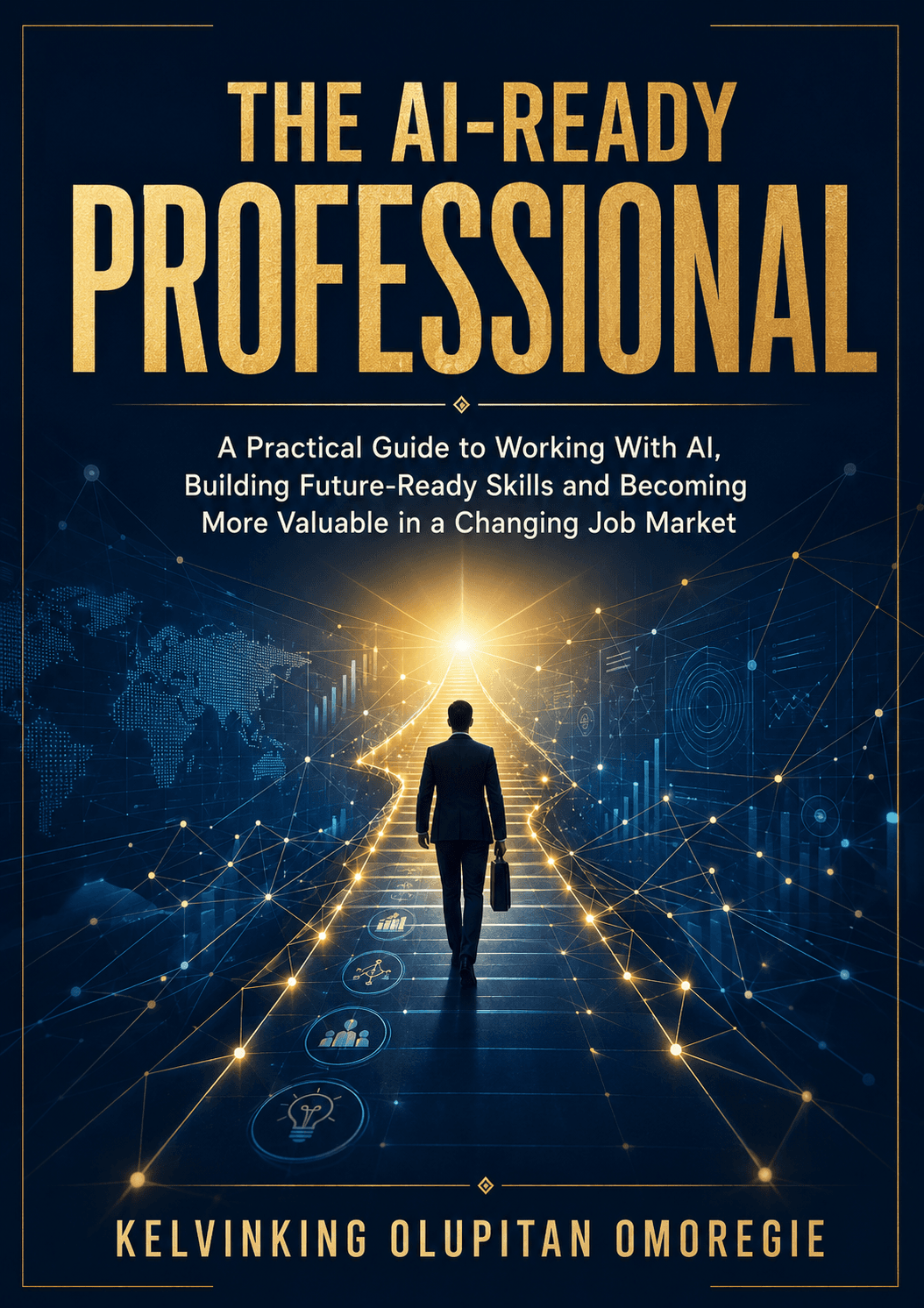
That's the gap The AI-Ready Professional was written to close — a practical five-part framework (Verify, Augment, Learn, Use your human strengths, Evidence your results) for employees, freelancers, managers, and career-changers who want a real implementation plan, not another list of prompts. It ends with a focused 90-day plan for putting it into practice, one deliberate step at a time.
The professionals who come out ahead over the next few years won't be the ones who used AI the most. They'll be the ones who knew, deliberately, when not to.